If you are exploring government contracts or business opportunities, you will often come across the word “tender.” But what is a tender, how does it work, and why do businesses participate in tenders?
A tender is a formal invitation issued by an organisation to suppliers, contractors, manufacturers, or service providers to submit competitive bids for specific goods, services, or work. The organisation evaluates the received bids according to predefined requirements and selects a suitable bidder for the contract.
Tenders are widely used by government departments, public sector organisations, local authorities, and private companies to purchase goods and services through a structured procurement process.
In this guide, we’ll explain the meaning of tender, how the tender process works, different types of tenders, important tender terms, and how businesses can find and participate in tender opportunities in India.
What Is a Tender?
In simple words, a tender is a formal request asking eligible businesses to submit an offer for supplying goods, providing services, or completing a project.
For example, suppose a government department needs 5,000 laptops for its offices.
Instead of directly purchasing them from one supplier, the department may publish a tender containing details such as:
- Number and specifications of laptops required
- Eligibility requirements for suppliers
- Delivery locations and timelines
- Earnest Money Deposit (EMD), if applicable
- Documents bidders need to submit
- Technical requirements
- Financial bid requirements
- Bid submission deadline
- Evaluation and contract conditions
Eligible laptop suppliers can then review the tender documents and submit their bids.
The department evaluates the bids according to the conditions stated in the tender and awards the contract based on the applicable evaluation and procurement rules.
Tender Meaning in Simple Words
Think of a tender as a structured business opportunity:
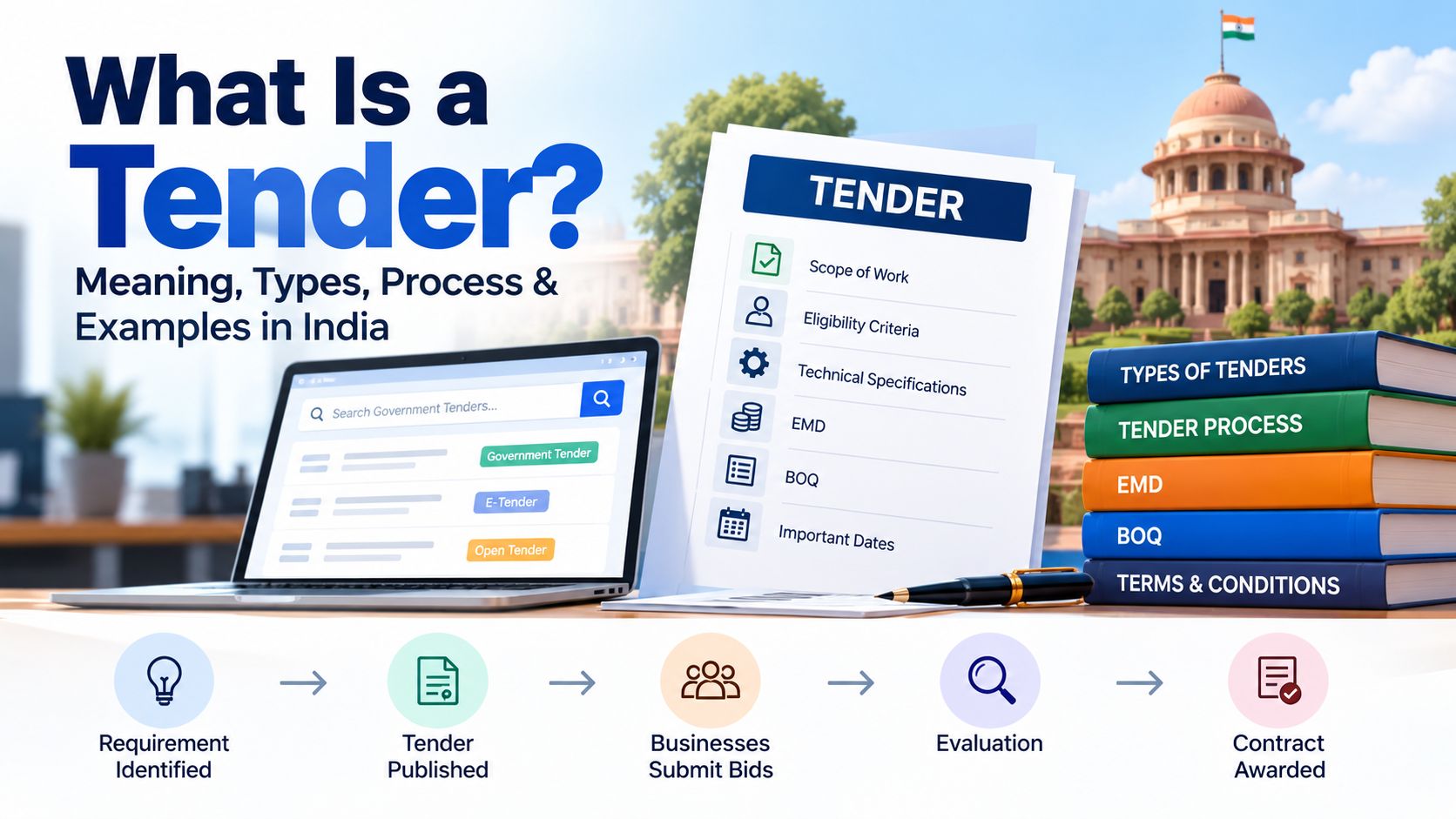
A buyer has a requirement → publishes a tender → eligible businesses submit bids → bids are evaluated → a contract is awarded to the selected bidder.
For businesses, tenders provide an opportunity to compete for contracts based on clearly defined requirements and evaluation criteria.
What Is a Tender in Business?
In business, a tender is a formal procurement process through which an organisation invites potential suppliers or contractors to compete for a contract.
The buyer could be:
- A government department
- Public Sector Undertaking (PSU)
- Municipal corporation
- Government-owned organisation
- Educational institution
- Hospital
- Large private company
- Infrastructure organisation
- Other public or private procurement authority
The bidder could be a:
- Manufacturer
- Supplier
- Distributor
- Contractor
- Service provider
- MSME
- Startup
- Consultancy
- Technology company
For example, a construction company may participate in road or building tenders, while an IT company may bid for software development, hardware supply, cybersecurity, cloud, or IT infrastructure contracts.
This is why tenders are relevant across a wide range of industries.
What Is a Government Tender?
A government tender is a formal procurement opportunity published by a government department, public authority, PSU, local body, or other eligible government organisation to procure goods, services, or works.
Government tenders may include requirements such as:
- Construction and infrastructure
- Machinery and equipment
- IT hardware and software
- Electrical equipment
- Medical supplies
- Transportation
- Facility management
- Security services
- Solar and renewable energy projects
- Consulting services
- Office supplies
- Maintenance and repair
- Professional services
Depending on the procurement, opportunities may be published through central government procurement systems, GeM, state e-procurement portals, railway procurement systems, PSU websites, and other official sources.
Businesses interested in government contracts therefore need to identify opportunities relevant to their products, services, location, experience, and eligibility.
How Does the Tender Process Work?
Although the exact process depends on the tendering authority and type of procurement, a typical tender process follows these stages:
1. Requirement Is Identified
The buying organisation identifies a requirement for particular goods, services, or works.
For example, a government authority may need road construction work, medical equipment, solar panels, software, or maintenance services.
2. Tender Is Published
The organisation prepares and publishes tender documents containing the scope, eligibility requirements, technical specifications, important dates, bid conditions, and other procurement information.
3. Businesses Review the Tender
Interested businesses review the documents carefully to determine whether the opportunity is relevant and whether they meet the eligibility requirements.
This step is important because not every tender is suitable for every business.
4. Bid Is Prepared
Eligible bidders prepare the required submission.
Depending on the tender, this can include:
- Company information
- Registration documents
- Experience certificates
- Financial documents
- Technical proposal
- Compliance documents
- Required declarations
- EMD details
- BOQ or financial bid
5. Bid Is Submitted
The bidder submits the tender response according to the specified procedure and before the submission deadline.
In an e-tendering process, the submission is generally completed through the specified online procurement portal.
6. Bids Are Evaluated
The tendering authority evaluates submitted bids according to the criteria specified in the tender documents.
This may involve technical qualification, document verification, financial evaluation, presentations, samples, or other tender-specific requirements.
7. Contract Is Awarded
After the evaluation process is completed, the contract is awarded according to the applicable tender conditions and procurement rules.
A simplified tender process therefore looks like:
Requirement → Tender Publication → Tender Discovery → Eligibility Check → Bid Preparation → Bid Submission → Evaluation → Contract Award
What Are the Different Types of Tenders?
Tender terminology and procedures can vary between organisations, but businesses commonly encounter the following types.
Open Tender
An open tender allows eligible suppliers or contractors that meet the stated requirements to participate.
It is commonly used where broader competition is required.
Limited Tender
In a limited tender, bids are invited from a restricted or selected group of suppliers or vendors rather than being open to everyone.
Single Tender
A single tender involves procurement from a single source or supplier in circumstances permitted under the applicable procurement rules.
Global Tender
A global tender may allow participation from eligible international suppliers or companies in addition to domestic bidders, subject to the tender conditions.
E-Tender
An e-tender is conducted electronically through an online procurement system.
Tender documents, corrigenda, bid submission, and other parts of the process may be handled digitally through the designated portal.
What Information Does a Tender Usually Contain?
Before participating, businesses should carefully read the complete tender documents.
A tender may contain:
Scope of Work
Explains exactly what goods, services, or work the buyer requires.
Eligibility Criteria
Defines the conditions a bidder must satisfy to participate.
These may relate to experience, turnover, certifications, previous projects, registrations, or other requirements.
Technical Specifications
Describe the technical standards, features, quality, performance, or specifications expected by the buyer.
Important Dates
These may include:
- Tender publication date
- Pre-bid meeting date
- Clarification deadline
- Bid submission deadline
- Bid opening date
EMD
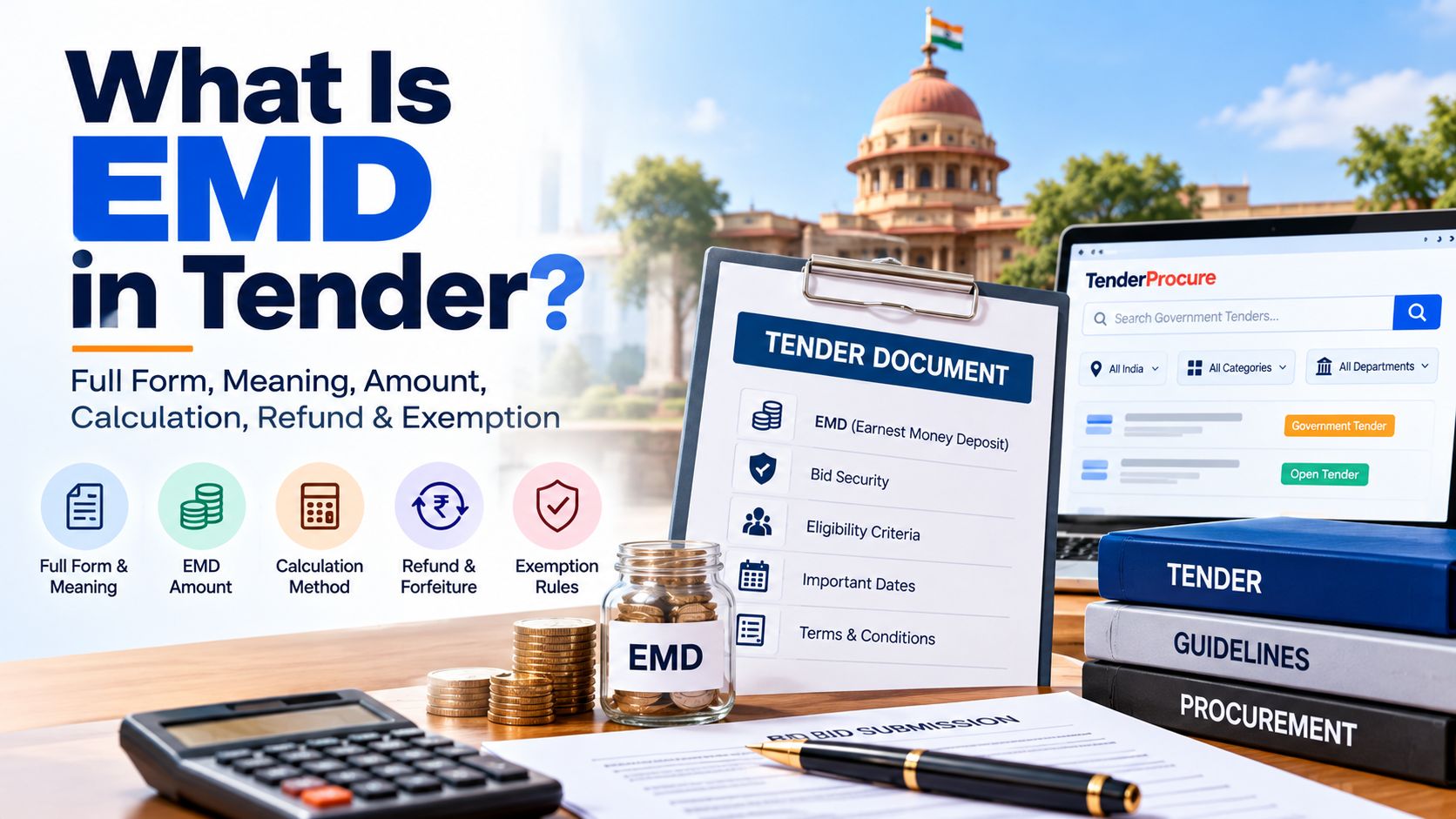
EMD (Earnest Money Deposit) is an amount that may be required from bidders as part of the tender process, subject to the tender conditions and applicable exemptions.
The amount, payment method, exemption conditions, refund terms, and other requirements should always be checked in the specific tender document.
BOQ
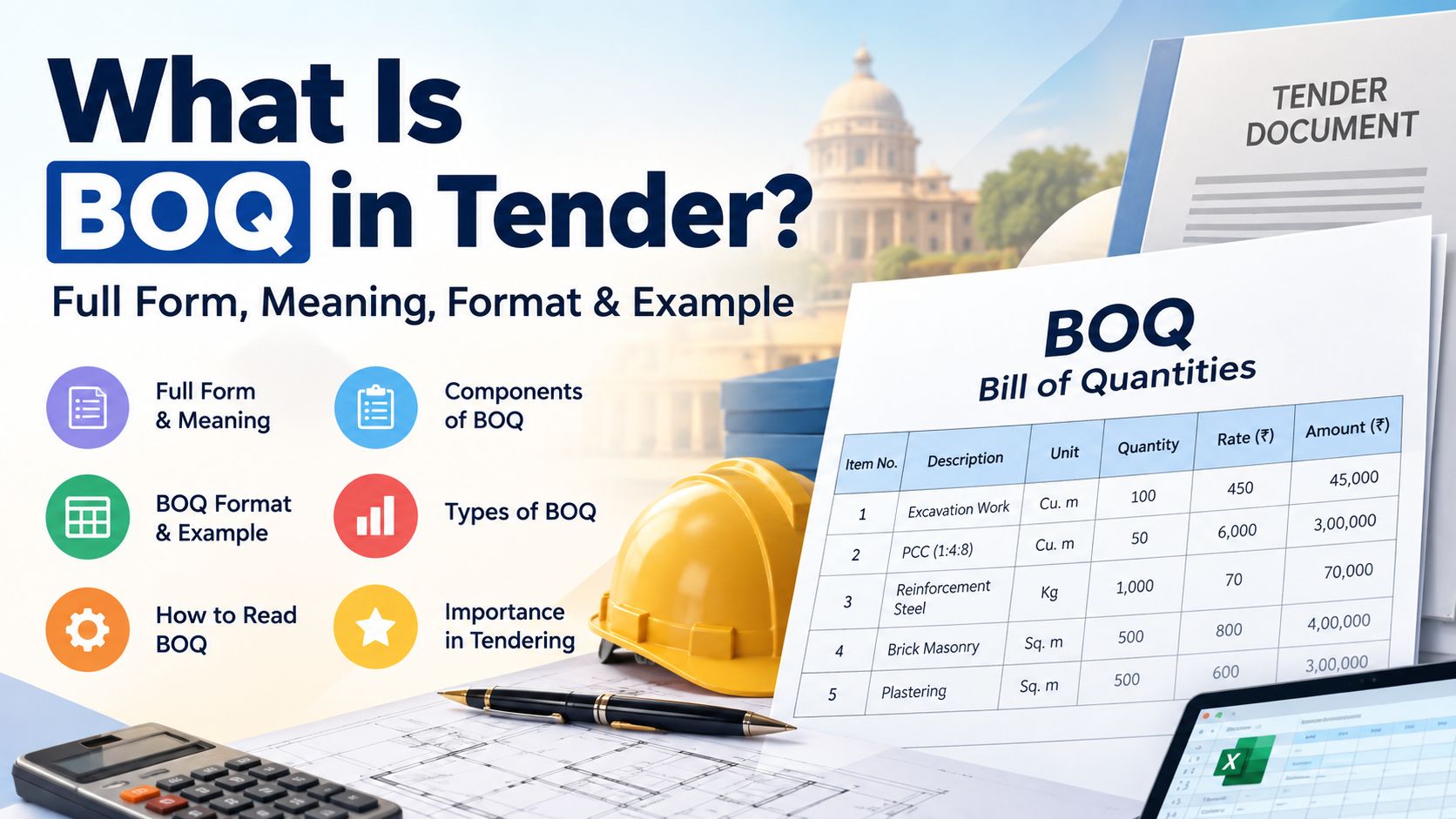
BOQ (Bill of Quantities) generally provides an itemised description of required work, goods, quantities, units, and related information used for preparing the financial bid, depending on the nature of the tender.
Evaluation Criteria
The tender documents explain how bids will be assessed and what conditions bidders must meet.
Terms and Conditions
These may cover payment terms, delivery requirements, performance obligations, penalties, warranties, security requirements, and contractual conditions.
Tender vs Bid vs Quotation vs Contract
These terms are related but do not mean exactly the same thing.
Term Meaning Tender A formal invitation or procurement process through which an organisation seeks offers from eligible businesses.Bid: The offer or response submitted by a supplier or contractor against the tender.Quotation: A price offer for specified goods or services, often used in comparatively simpler procurement situations.Contract: The legally binding agreement created after the procurement and award process is completed.
An easy way to understand this is:
Buyer publishes a tender → Supplier submits a bid → Bid is evaluated → Selected bidder receives the contract.
Example of a Tender
Suppose a state government department requires 5,000 laptops for government offices.
The department publishes a tender specifying:
- Required laptop specifications
- Quantity: 5,000 units
- Delivery locations
- Required bidder experience
- Minimum eligibility requirements
- Required certifications
- EMD conditions
- Delivery timeline
- Technical bid requirements
- Financial bid format
- Submission deadline
A laptop manufacturer, authorised distributor, or eligible supplier finds the tender and reviews the requirements.
If the business meets the eligibility conditions, it prepares and submits its technical and financial bid.
The department then evaluates the submitted bids according to the tender conditions.
After completing the required evaluation process, the contract is awarded to the successful bidder according to the applicable procurement rules.
This example shows why finding a tender is only the first step. A business also needs to understand the requirements, confirm eligibility, prepare the necessary documents, submit the bid correctly, and meet the specified deadlines.
What Is a Tender Notice?
A tender notice is an announcement informing potential bidders about a procurement opportunity.
Depending on the procurement, it may contain important information such as:
- Tendering authority
- Nature of requirement
- Tender reference number
- Estimated value, where disclosed
- Important dates
- Eligibility information
- EMD or tender fee information
- Bid submission details
- Link or instructions for accessing the complete tender documents
Businesses should not rely only on the tender notice when making a bidding decision. The complete tender documents should be reviewed before participating.
How to Find Government Tenders in India
Government tender opportunities in India are published across multiple procurement sources.
Depending on the organisation and procurement, businesses may need to monitor:
- Government e-procurement portals
- Government e-Marketplace (GeM)
- Central procurement systems
- State e-procurement portals
- Public Sector Undertakings
- Railway procurement sources
- Municipal and local authorities
- Individual government organisation websites
For a business bidding regularly, checking multiple sources manually can take considerable time.
Tender discovery platforms such as TenderProcure can help businesses search tender opportunities using criteria such as keywords, location, authority, category, and other relevant filters from a centralised interface.
How to Apply for a Tender
The exact application procedure depends on the tender, but the general process is:
- Find a relevant tender for your product, service, or industry.
- Download and read the complete tender documents.
- Check the eligibility requirements before preparing the bid.
- Prepare the required technical, financial, and supporting documents.
- Complete EMD or other required formalities, where applicable.
- Submit the bid through the specified process before the deadline.
- Track corrigenda, clarifications, evaluation updates, and results.
Never assume that the process will be identical for every tender. The requirements stated in the specific tender documents and the applicable procurement portal should be followed.
Important Tender Terms Every Beginner Should Know
Understanding basic terminology makes reading tender documents easier.
NIT — Notice Inviting Tender: A formal notice inviting eligible parties to participate in a tender.
EMD — Earnest Money Deposit: A bid-related monetary requirement that may apply according to the tender conditions.
BOQ — Bill of Quantities: An itemised schedule commonly used to describe quantities, units, items, and pricing requirements.
Bidder: A business or entity submitting a bid.
Tendering Authority: The organisation issuing and managing the tender.
Technical Bid: The portion of a bid dealing with technical compliance, qualifications, experience, specifications, and related requirements.
Financial Bid: The commercial or pricing portion of the bid.
Corrigendum: An official amendment, correction, clarification, or update issued in relation to a tender.
Bid Opening: The stage at which submitted bids are opened according to the specified procedure.
Tender Award: The outcome through which the successful bidder is selected and the procurement proceeds toward contract award according to the applicable process.
Why Are Tenders Important for Businesses?
Tenders can provide businesses with access to opportunities from government departments, PSUs, public authorities, and private organisations.
For manufacturers, contractors, suppliers, service providers, and other businesses, tendering can help:
- Identify new contract opportunities
- Reach new government or institutional buyers
- Expand into new locations or sectors
- Build experience in institutional procurement
- Develop a more consistent opportunity pipeline
- Compete for larger or recurring requirements
However, success in tendering is not simply about submitting more bids.
Businesses need to identify relevant opportunities, understand eligibility requirements, prepare compliant submissions, and focus resources on tenders that genuinely match their capabilities.
Frequently Asked Questions
What is a tender in simple words?
A tender is a formal invitation from an organisation asking eligible businesses to submit competitive offers for specified goods, services, or work.
What is a tender in business?
In business, a tender is a structured procurement process through which a buyer invites suppliers, contractors, or service providers to compete for a contract.
What is a government tender?
A government tender is a procurement opportunity issued by a government department, PSU, public authority, local body, or other eligible government organisation for purchasing goods, services, or works.
Who can apply for a tender?
Eligibility depends on the individual tender. Manufacturers, suppliers, contractors, service providers, MSMEs, startups, consultants, and other eligible organisations may participate if they meet the stated requirements.
What is the difference between a tender and a bid?
A tender is the procurement invitation or process initiated by the buyer, while a bid is the offer submitted by a supplier or contractor in response to that tender.
What is EMD in a tender?
EMD stands for Earnest Money Deposit. It may be required as part of a tender submission, subject to the specific tender conditions, procurement rules, and applicable exemptions.
What is BOQ in a tender?
BOQ stands for Bill of Quantities. It is generally an itemised schedule containing descriptions, quantities, units, and related information used in preparing or evaluating the financial component of certain tenders.
Where can I find government tenders in India?
Government tenders can be published across GeM, central and state e-procurement portals, PSU and railway procurement systems, individual government websites, and other official sources. Tender discovery platforms such as TenderProcure can also help businesses search relevant opportunities from a centralised interface.
Find Relevant Tender Opportunities with TenderProcure
Understanding what a tender is gives you the foundation. The next challenge is finding opportunities that actually match your business.
TenderProcure helps businesses discover and track government and procurement opportunities using powerful search, filters, alerts, and tender intelligence.
Instead of spending time checking multiple sources for relevant opportunities, businesses can use TenderProcure to search tenders based on their requirements and stay updated on opportunities that matter to them.