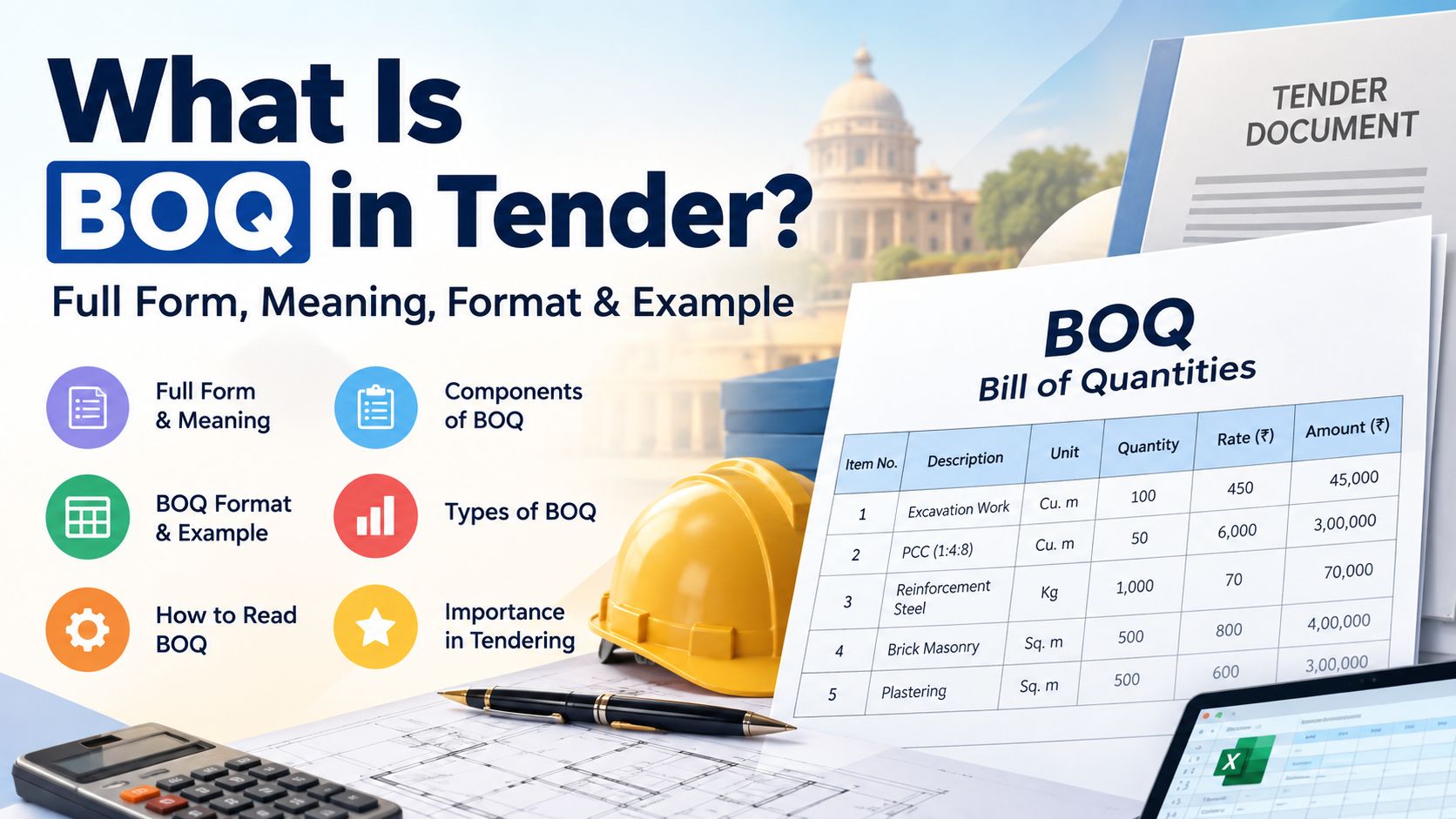
BOQ in tender means Bill of Quantities, a structured document or price schedule that lists the items, work, goods, services, quantities, units, and other pricing-related details required for a tender.
It helps bidders understand what needs to be priced and in what quantity, while allowing the tendering authority to receive financial offers in a consistent format.
In many e-tenders, the BOQ is provided as an Excel file or another prescribed price schedule that bidders must complete according to the tender instructions.
For businesses participating in government procurement, understanding the BOQ is important because errors in rates, quantities, units, taxes, or the prescribed format can affect the financial bid.
This guide explains the BOQ full form in tender, BOQ meaning, format, components, purpose, examples, preparation, and how to read a BOQ before submitting your bid.
What Is BOQ in Tender?
A BOQ, or Bill of Quantities, is a structured list of items and quantities used as part of the pricing or financial component of a tender.
Depending on the procurement, a BOQ may include:
- Item or serial number
- Description of work, goods, or services
- Unit of measurement
- Required quantity
- Bidder's rate
- Total amount
- Taxes or other pricing fields where applicable
- Additional pricing information required by the tender
The exact BOQ structure varies according to the type of procurement and the tendering authority.
A simple way to understand it is:
Tender Requirement → BOQ Issued → Bidder Reviews Items & Quantities → Rates Entered → Total Bid Value Calculated → Financial Bid Submitted
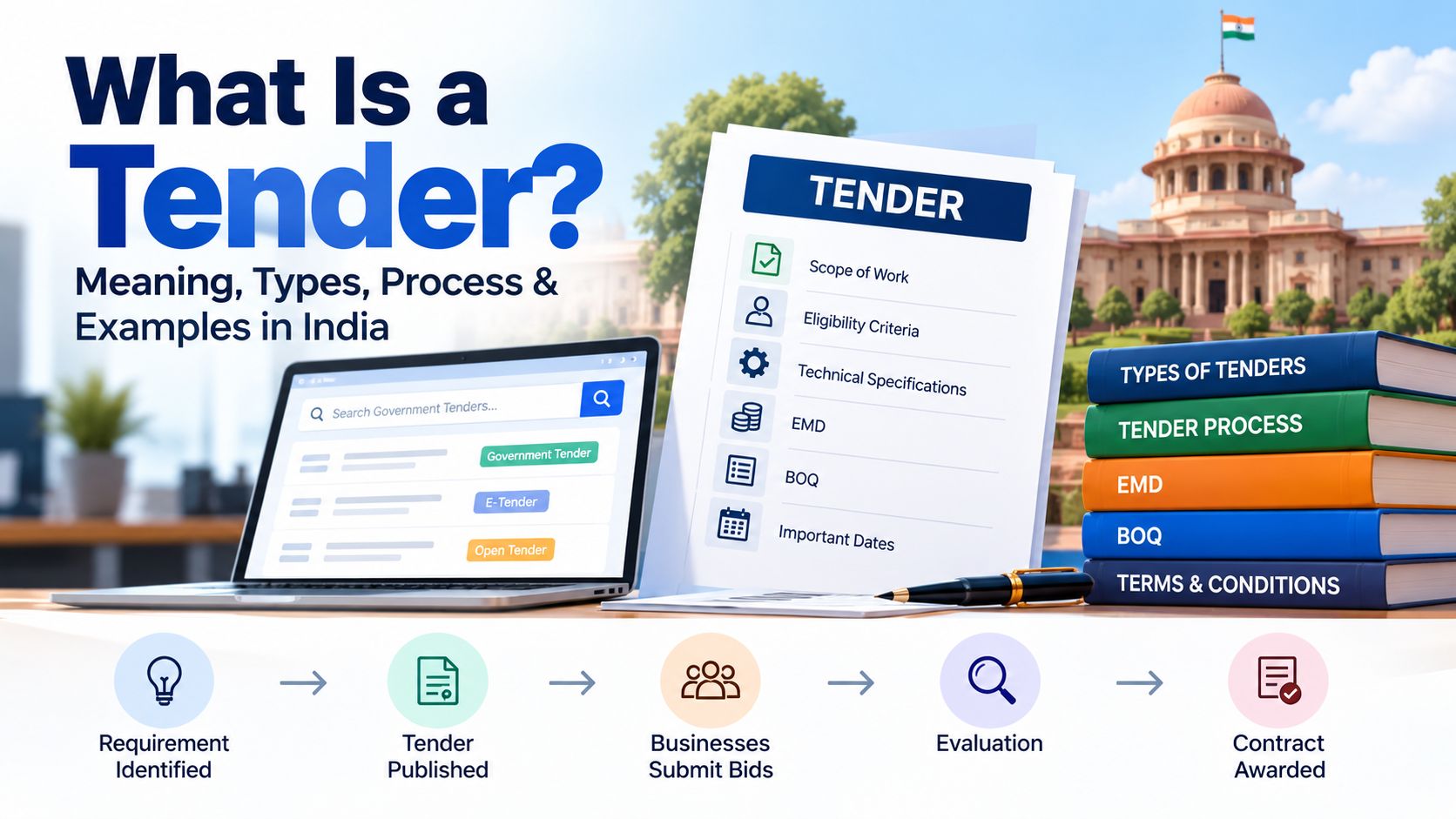
If you are new to the overall process, understanding what a tender is and how the tender process works first will make concepts such as BOQ, EMD, technical bids, and financial bids easier to understand.
What Is the Full Form of BOQ in Tender?
The BOQ full form in tender is Bill of Quantities.
In procurement, a BOQ is commonly associated with the price schedule or financial part of a bid.
For example, Government of India procurement material defines BOQ as Bill of Quantities and refers to it as the price schedule in an Excel sheet.
The term is particularly common in construction and works contracts, but BOQ or similarly structured price schedules can also appear in procurement of goods and other categories.
The purpose is straightforward:
The buyer specifies what needs to be priced, and the bidder provides the required financial information in the prescribed format.
What Is the Meaning of BOQ in Tender?
The meaning of BOQ in tender is easier to understand with a simple example.
Suppose a government authority publishes a tender for electrical installation work.
Instead of asking a contractor to submit only one overall price, the tender may provide a BOQ containing individual items such as:
- Electrical cable
- Distribution boards
- Switches
- Conduits
- Installation work
- Testing and commissioning
Each item may have a specified unit and quantity.
The bidder reviews these items and enters the required rates according to the tender instructions.
This creates a structured financial offer that can be evaluated according to the tender conditions.
Therefore, BOQ in tender is not simply a cost estimate. It can form an important part of the bidder's financial submission and, depending on the contract, may also have significance during contract execution.
What Is BOQ in Procurement?
In procurement, a Bill of Quantities provides a structured breakdown of the items or requirements for which bidders need to quote prices.
Its exact role depends on what is being procured.
For a works tender, the BOQ may contain construction activities and estimated quantities.
For a goods tender, the price schedule may list individual products, quantities, units, and applicable pricing fields.
For another type of procurement, the structure may be adapted to the requirements of that tender.
A BOQ helps create a common pricing structure so participating bidders submit their financial information against the same defined requirements.
What Information Does a BOQ Contain?
There is no single BOQ format used for every tender, but common fields may include the following.
Item Number
A serial or reference number used to identify each BOQ item.
Description
A description of the work, product, material, or service to be priced.
Unit
The measurement used for the item.
Examples can include:
Nos. — Number
Kg — Kilogram
M — Metre
Sq. m — Square metre
Cu. m — Cubic metre
Lot — Lumped group of items
LS — Lump sum, where applicable
The actual units depend on the tender.
Quantity
The quantity specified for the particular BOQ item.
Rate
The price quoted by the bidder for the specified unit or item, where the BOQ requires a rate.
Amount
The amount corresponding to the item, which may be calculated from the quantity and rate or handled according to the prescribed BOQ format.
Taxes and Other Pricing Fields
Depending on the tender, additional fields relating to GST, duties, freight, discounts, or other commercial components may be included or governed by separate instructions.
Bidders should follow the tender's pricing instructions instead of assuming how taxes or additional charges should be entered.
BOQ Format in Tender
A simplified BOQ format might look like this:
Item No. Description Unit Quantity Rate (₹) Amount (₹)
1 Electrical Cable Metre 1,000 120 1,20,000
2 Distribution Board Nos. 10 8,000 80,000
3 LED Light Fixture Nos. 100 1,500 1,50,000
4 Installation & Testing Lot 1 75,000 75,000
Illustrative Total: ₹4,25,000
This table is only an example to explain how a BOQ can be structured.
An actual tender may contain significantly more fields, protected cells, formulas, taxes, multiple sheets, or tender-specific pricing instructions.
Always use the BOQ file and format issued with the actual tender.
Example of BOQ in a Tender
Consider a public authority inviting bids for renovation of an office building.
The BOQ might include:
Item 1: Removing existing flooring
Unit: Sq. m
Quantity: 500
Item 2: Supplying and installing new tiles
Unit: Sq. m
Quantity: 500
Item 3: Interior painting
Unit: Sq. m
Quantity: 1,500
Item 4: Electrical modifications
Unit: Lot
Quantity: 1
The bidder reviews the tender specifications, drawings, conditions, BOQ, and other relevant documents before entering rates.
If the BOQ asks for item rates, the bidder quotes the required rates against those items.
The resulting financial offer is then evaluated according to the tender conditions.
How Does BOQ Work in a Tender?
The process can generally be understood in five stages.
1. Tendering Authority Prepares the Requirement
The authority identifies the work, goods, or services that need to be procured.
2. BOQ or Price Schedule Is Issued
The BOQ is provided with the tender documents where applicable.
3. Bidder Reviews the BOQ
Before entering prices, the bidder should review the BOQ together with relevant:
- Technical specifications
- Scope of work
- Drawings
- Terms and conditions
- Delivery or execution requirements
- Taxes and commercial conditions
- Corrigenda
4. Bidder Enters the Required Prices
The bidder completes the pricing fields according to the instructions.
5. Financial Bid Is Submitted
The completed BOQ or prescribed price schedule becomes part of the financial submission where the tender requires it.
The exact procedure varies by procurement platform and tender.
How to Read a BOQ
Knowing how to read a BOQ is important before deciding your price.
Do not start with the rate column.
Start by understanding what you are actually being asked to supply or execute.
Step 1: Read the Item Description
Understand the complete scope represented by each item.
Do not rely only on a short BOQ description if the tender refers to detailed specifications elsewhere.
Step 2: Check the Unit
A rate per metre is different from a rate per square metre, kilogram, number, or lump sum.
A unit misunderstanding can create a major pricing error.
Step 3: Check the Quantity
Review the quantity stated against each item and understand how it relates to the scope.
Step 4: Review Specifications and Drawings
For works or technical procurements, the BOQ should not be read in isolation.
Cross-check relevant specifications, drawings, schedules, and scope documents.
Step 5: Understand What the Rate Must Include
Check whether the quoted rate must include items such as:
- Material
- Labour
- Transportation
- Installation
- Testing
- Packaging
- Insurance
- Duties
- GST or other taxes
The applicable inclusions depend entirely on the tender conditions.
Step 6: Check Corrigenda
A corrigendum may revise quantities, specifications, BOQ files, deadlines, or other tender conditions.
Always verify that you are working with the latest BOQ before submitting your financial bid.
How Is a Bill of Quantities Prepared?
The preparation of a Bill of Quantities depends heavily on the procurement type.
For construction and works projects, preparation may involve studying:
- Drawings
- Technical specifications
- Scope of work
- Measurements
- Work items
- Units
- Estimated quantities
The tendering authority or its appointed professionals generally prepare the BOQ or price schedule issued to bidders.
The bidder's role is usually to carefully review the issued BOQ and complete the required pricing fields according to the tender instructions.
The process can broadly be represented as:
Scope & Drawings → Identify Work Items → Measure Quantities → Define Units → Prepare BOQ → Issue with Tender
In an e-tender, the authority may provide the final BOQ as a prescribed spreadsheet or electronic format.
What Is a Schedule of Quantities?
A Schedule of Quantities is a structured schedule listing work items and their corresponding quantities.
Depending on the procurement system, organisation, and contract, terminology such as Bill of Quantities, Schedule of Quantities, or Price Schedule may be used in related contexts.
The tender documents should always be treated as the source of truth for how a particular schedule is defined and used.
Schedule of Quantities vs Bill of Quantities
The terms are sometimes used similarly, but their exact meaning can depend on the contract and procurement context.
A Bill of Quantities commonly provides a structured list of items, descriptions, units, and quantities used for pricing.
A Schedule of Quantities also lists quantities of required work or items and may serve a similar pricing or measurement function.
Instead of assuming that the two terms always mean exactly the same thing, bidders should check how they are defined in the specific tender documents.
Types of BOQ Used in E-Tendering
Different procurement systems can use different BOQ formats.
The Government of India's eProcurement system, for example, provides bidder guidance for multiple BOQ formats, including item-rate, item-wise, and percentage BOQ formats.
Item-Rate BOQ
In an item-rate structure, bidders may be required to quote rates against individual BOQ items according to the prescribed format.
Item-Wise BOQ
An item-wise BOQ structures pricing around individual items or requirements.
Percentage BOQ
Some tenders use a percentage-based BOQ format where the bidder quotes according to the percentage mechanism specified by the tender.
These descriptions are general.
Always follow the BOQ instructions supplied with the specific e-tender rather than applying the rules of another BOQ format.
What Is BOQ in E-Tendering?
In e-tendering, BOQ is commonly provided electronically, often as an Excel-based price schedule.
On India's eProcurement system, tender listings can include BOQ files as separate downloadable tender documents, and the portal provides BOQ preparation guidelines for bidders.
When completing an electronic BOQ:
- Download the BOQ from the official tender source
- Read the tender-specific BOQ instructions
- Use the required software or format
- Enter data only in permitted fields
- Do not alter protected fields or the file structure unless specifically permitted
- Verify calculations and rates
- Save the file in the required format
- Upload it in the correct financial-bid section
- Check for revised BOQ files or corrigenda before final submission
The exact steps depend on the portal and tender.
BOQ vs Financial Bid
BOQ and financial bid are closely related, but they should not automatically be treated as identical terms in every tender.
A BOQ is the structured item-and-quantity or price schedule used to capture pricing information.
The financial bid is the bidder's overall commercial submission according to the tender requirements.
In many tenders, the completed BOQ forms a major part of the financial bid.
A simple way to understand the relationship is:
BOQ = Structured Pricing Document
Financial Bid = Commercial Submission
Always follow the terminology used in the specific tender.
BOQ vs BOM: What's the Difference?
BOQ is also sometimes confused with BOM.
BOQ — Bill of Quantities
Focuses on quantities and pricing of work, goods, or other tender requirements.
BOM — Bill of Materials
Generally lists the materials, components, parts, or assemblies required for a product or project.
The two documents can serve different purposes and should not be used interchangeably unless the procurement documents specifically define them that way.
Why Is BOQ Important in Tendering?
BOQ plays an important role for both the tendering authority and the bidder.
Provides a Common Pricing Structure
Bidders can quote against a predefined set of requirements.
Makes Financial Offers Easier to Compare
A structured format can help the authority evaluate commercial submissions according to the tender's evaluation method.
Helps Bidders Understand the Requirement
Item descriptions, units, and quantities provide useful information about the expected scope.
Supports Cost Planning
Businesses can use the BOQ along with specifications and other documents to estimate materials, labour, overheads, logistics, taxes, and margins where relevant.
Can Become Important During Contract Execution
In works contracts, BOQ quantities can be estimates, with payment based on actual measured quantities depending on the contract structure and conditions.
For this reason, the BOQ should be reviewed carefully before bidding.
BOQ and EMD: Are They Related?
BOQ and EMD are separate tender concepts.
BOQ relates primarily to the items, quantities, and pricing structure of the bid.
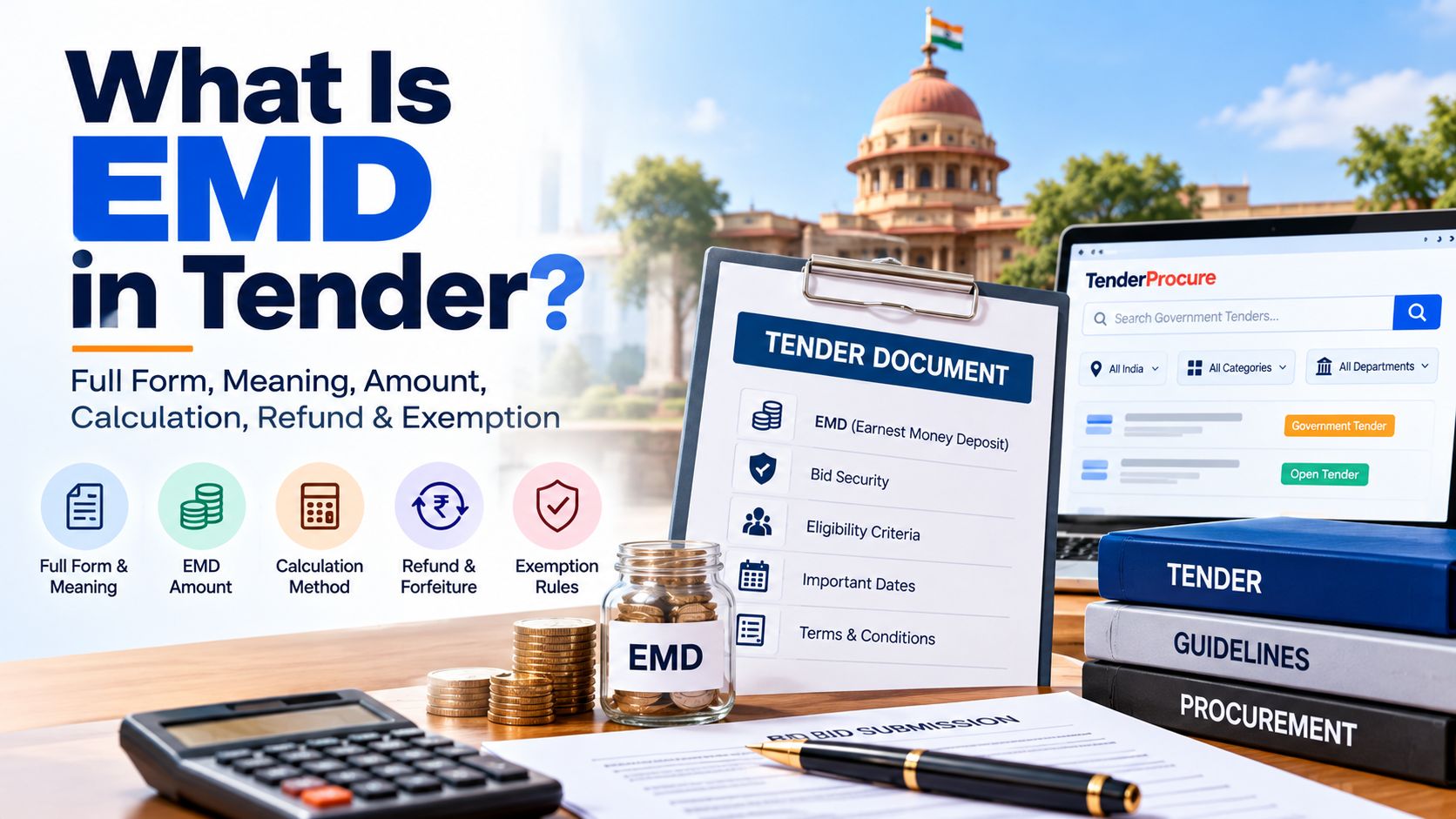
EMD (Earnest Money Deposit) is a form of bid security that may be required under the tender conditions.
A bidder may therefore need to handle both requirements during the same tender:
EMD → Bid-security requirement
BOQ → Pricing/financial requirement
If you are unfamiliar with bid security, read our complete guide on EMD in tender before submitting a government bid.
Common BOQ Mistakes Bidders Should Avoid
BOQ mistakes can directly affect the financial submission, so the file should be reviewed carefully before upload.
Entering a Rate Against the Wrong Item
Always match the rate with the correct description, unit, and quantity.
Misreading the Unit
Confusing metre with square metre, number with lot, or another unit can significantly change pricing.
Ignoring Technical Specifications
The BOQ description may not contain every technical requirement.
Review referenced specifications and drawings.
Editing Restricted Cells or Formulas
Electronic BOQs may contain protected cells, formulas, and predefined structures.
Do not modify them unless the instructions explicitly allow it.
Using an Old BOQ File
If a revised BOQ has been issued through a corrigendum, using an older version can create problems.
Leaving Required Fields Blank
Check every field that the bidder is required to complete.
Incorrect Tax Treatment
Do not assume whether GST, freight, duties, or other costs should be included or entered separately.
Follow the commercial conditions.
Failing to Review the Final Total
Before submission, verify rates, calculations, totals, and any applicable rounding requirements.
BOQ Checklist Before Tender Submission
Before uploading your financial bid, check:
- Am I using the latest BOQ file?
- Have I checked all corrigenda?
- Do I understand every item description?
- Are the units correct?
- Have I reviewed the specified quantities?
- Have I checked related drawings and technical specifications?
- Do I understand what each quoted rate must include?
- Have I entered rates only in permitted fields?
- Have I avoided changing the BOQ structure?
- Have I checked taxes and commercial requirements?
- Are all required fields completed?
- Have I verified the final amount?
- Is the BOQ saved in the required format?
- Am I uploading it in the correct financial-bid section?
A final BOQ review before submission can help prevent avoidable pricing and compliance errors.
Frequently Asked Questions About BOQ in Tender
What is BOQ in tender?
BOQ in tender stands for Bill of Quantities. It is a structured document or price schedule listing items, descriptions, units, quantities, and pricing fields required for the financial bid.
What is the BOQ full form in tender?
The full form of BOQ in tender is Bill of Quantities.
What does BOQ mean in procurement?
In procurement, BOQ generally refers to a structured schedule used to list items or requirements and capture the corresponding pricing information from bidders.
What is a BOQ?
A BOQ is a Bill of Quantities. It provides an organised breakdown of items, work, goods, or services and their quantities for pricing and procurement purposes.
What is a Bill of Quantity?
The commonly used term is Bill of Quantities (BOQ). It is a structured document containing quantities and other information used for pricing work, goods, or services.
Is BOQ the same as a financial bid?
Not necessarily. The BOQ is commonly a pricing document that forms part of the financial bid, while the financial bid refers more broadly to the bidder's commercial submission.
What is a Schedule of Quantities?
A Schedule of Quantities lists work items or requirements and their quantities. Its exact relationship with a BOQ depends on the terminology and conditions used in the specific tender.
What are the main components of a BOQ?
Common components include item number, description, unit, quantity, rate, and amount. Actual fields vary between tenders.
Who prepares the BOQ?
The BOQ issued with a tender is generally prepared by the tendering authority or professionals appointed for the procurement. Bidders then complete the required pricing fields according to the tender instructions.
Can I modify a BOQ Excel file?
Only where the tender instructions permit it. In e-tendering, bidders should not alter protected cells, formulas, file structure, or prescribed formats unless specifically instructed to do so.
What is an item-rate BOQ?
An item-rate BOQ is a format in which pricing is structured around individual items and bidders quote rates according to the tender's prescribed format.
Why is BOQ important in tendering?
BOQ provides a structured basis for pricing, helps bidders understand quantities and requirements, and supports financial evaluation according to the tender conditions.
Find Tenders Relevant to Your Business
Understanding a BOQ is important when preparing a financial bid, but first you need to identify procurement opportunities that match your business.
TenderProcure helps businesses discover and track government and procurement opportunities using tender search, filters, alerts, and tender intelligence.
Search opportunities by keyword, category, location, authority, and other relevant criteria.
Continue Learning About Tenders
New to government procurement? Start with What Is a Tender? Meaning, Types, Process & Examples in India to understand the complete tendering process.
You can also read What Is EMD in Tender? Full Form, Meaning, Amount & Refund to understand bid security, EMD calculation, refund, forfeiture, and exemption requirements.
Together, these guides will help you understand three fundamental tender concepts:
Tender → EMD → BOQ